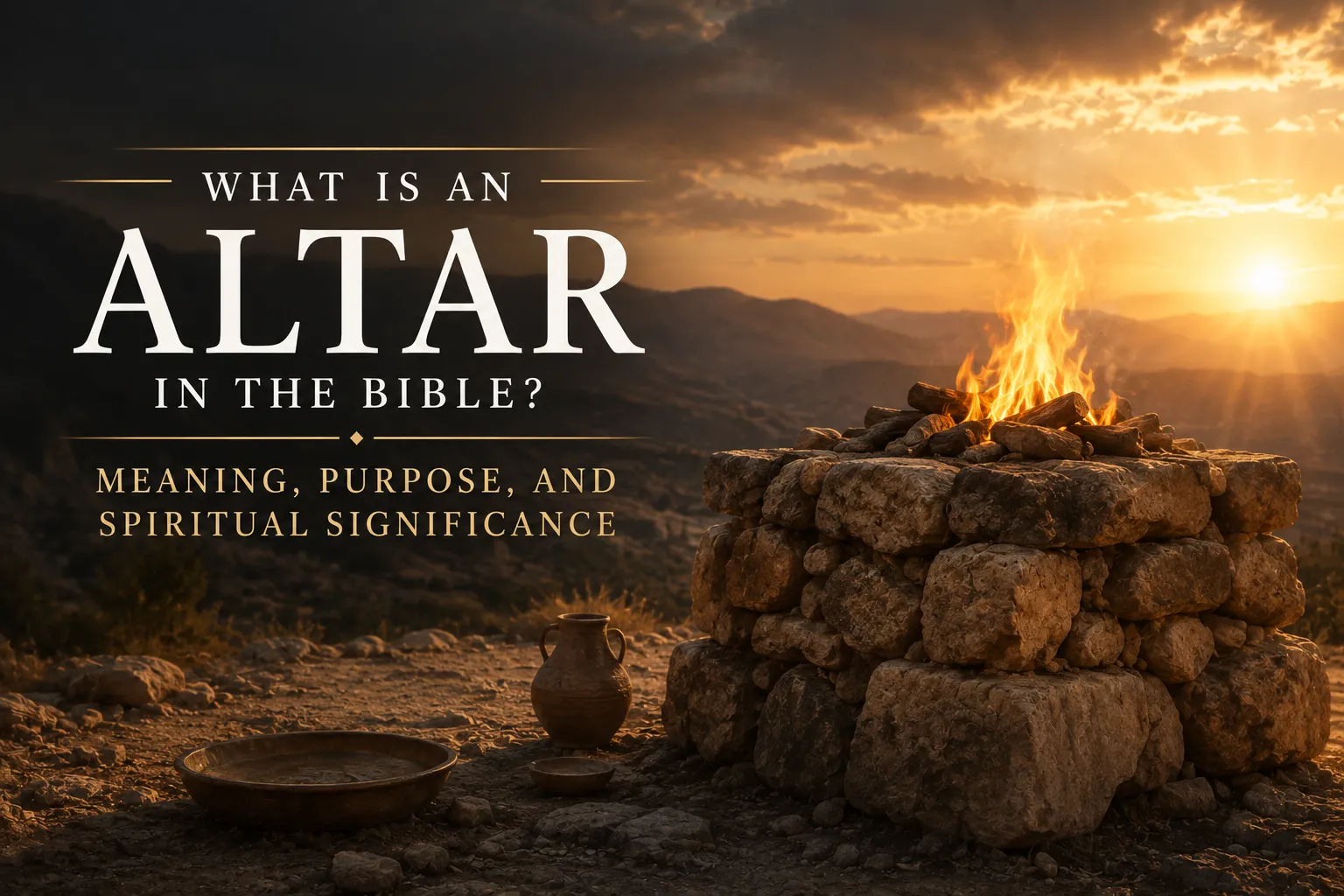
What Is an Altar in the Bible? Meaning, Purpose, and Spiritual Significance
Well, what is an altar in the bible? Meaning, Purpose, and Spiritual Significance
Bible Verses (KJV)
"And Noah built an altar unto the LORD; and took of every clean beast, and of every clean fowl, and offered burnt offerings on the altar.
— Genesis 8:20 (KJV)
Additional Supporting Verses
And Abram passed through the land... And there he built an altar to the LORD, who appeared to him.
— Genesis 12:6–7 (KJV)
"And Elijah took twelve stones, as the number of the tribes of the sons of Jacob, and he built an altar in the name of the LORD...
— 1 Kings 18:31–32 (KJV)
We have an altar, of which they have no right to eat, who serve it the tabernacle.
— Hebrews 13:10 (KJV)
📅 Approximate Year Written
Genesis: Around 1445–1400 BC
1 Kings: Around 560–540 BC
Hebrews: Around AD 60–70
Altars are significant in the worship of the Bible throughout the entire course of the book of Genesis to Revelation. They were locations where people could gather with God, sacrifice, give thanks, renew covenants and remember God's faithfulness.
🏛️ What Is an Altar?
An altar is a building where worship is conducted.
In the Bible, altars were usually made from:
Natural stones
Uncut rocks
Earth (soil)
Bronze (in the Tabernacle)
Gold (inside the Tabernacle and Temple)
The word for altar in Hebrew is mizbeach (מִזְבֵּחַ) which means "place of sacrifice.
An altar was nothing like a home for God. But it was a centre where people came to Him in worship and sacrifice.
What is the purpose of Altars?
In the Bible, people used to establish altars for various reasons.
1. To Worship God
The first expression of worship was in the form of an altar.
After the Flood:
Noah made an altar to the LORD.
— Genesis 8:20 (KJV)
The first act of Noah, after he came out of the ark, was to give thanks to God.
2. To Offer Sacrifices
Prior to Jesus' death, people sacrificed on altars.
Common offerings included:
Burnt offerings
Peace offerings
Sin offerings
Grain offerings
Thank offerings
These sacrifices symbolized:
Worship
Repentance
Gratitude
Fellowship with God
The Old Testament sacrifices were only a foreshadowing of the one sacrifice that was enough, the sacrifice of Jesus Christ (Hebrews 10:1-14).
3.To remember God's faithfulness
Numerous biblical altars were memorials.
The phrase “Abraham built the altars where God appeared to him” means that Abraham made an altar at each place where he met God.
These were a reminder to future generations of God's promises.
Examples include:
Shechem (Genesis 12)
Bethel (Genesis 13)
Moriah (Genesis 22)
Each altar symbolized an important experience of God.
4. To Renew Covenant
God's people would often recommit themselves to God after significant events.
Joshua built an altar in the Promised Land (Joshua 8).
Elijah re-built the Lord's altar on Mount Carmel, calling the nation back to true worship (1 Kings 18).
The Altar in the Tabernacle
Two of the most significant altars consisted of God's command to Moses to build the Tabernacle.
The Bronze Altar
Located in the courtyard.
Purpose:
Animal sacrifices.
Burnt offerings.
Atonement.
This is the first object that would be seen by worshippers when they approached the Tabernacle.
It highlighted the sacrifice needed in forgiveness.
The Golden Altar of Incense
Within the Holy Place.
Purpose:
Burning incense in the morning and evening.
The flames of the rising incense represented the prayers of God's people rising to Him.
Incense is later associated with the prayers of believers (Revelation 8:3-4).
How does the altar remind us of Jesus?
The New Testament teaches that the sacrifices of the Old Testament and the altar were figurative and were in anticipation of Christ.
Jesus became:
The perfect sacrifice.
The High Priest of All.
The One who gave Himself once for all!
Hebrews teaches:
For, by one offering he hath perfected for ever them that are sanctified.
— Hebrews 10:14 (KJV)
Now there is no longer any need for repeated animal sacrifices due to Christ's sacrifice.
Do Christians Need Physical Altars Today?
Most Christian traditions hold that no longer should anyone have to offer sacrifices on an altar of a different kind for the purpose of gaining salvation; Jesus has accomplished that.
Many churches use the word "altar" for the communion table, or for the front of the church where people pray.
That's simply because it is church tradition, not a command of the New Testament.
The New Testament is important because it teaches us that we as believers are to become:
The temple of the Holy Spirit (1 Corinthians 6:19).
Living sacrifices for God (Romans 12:1).
What Does Archaeology Tell Us?
Many ancient altars have been found in Israel and the surrounding area.
These include:
Stone altars.
Horned altars.
Incense altars.
Sacrificial platforms.
A classic example is the altar found at Mount Ebal, which has been suggested to be part of Joshua's altar, as described in Joshua 8. This identification is still controversial.
Erected in the ancient Near East, altars and cultic installations have been excavated at sites like Tel Beersheba, Megiddo, and Arad, providing evidence of the importance of altar worship in this region.
Real-World Example
Suppose you are given a medal for an event that is significant.
It is not an achievement to have won the medal, it is a reminder of what happened.
Likewise, the biblical altars were tangible reminders of God's covenant and His forgiveness and faithfulness.
The altar was a reference to God.
Easy Explanation
The altar was a place where people worshiped God.
It was used for:
Sacrifice.
Prayer.
Thanksgiving.
Remembering God's promises.
Renewing commitment.
In modern times, Christians think that Jesus accomplished what the Old Testament altar was supposed to do with its perpetual sacrifice of Himself.
Did You Know?
It was after the flood when Noah made the very first altar.
Abraham built several altars throughout Canaan.
Elijah re-built the Lord's altar with 12 stones, each symbolizing one of the 12 tribes of Israel.
The largest furniture of the Tabernacle courtyard was the Bronze Altar.
The Book of Hebrews provides us with a major teaching that the sacrificial system of the Old Testament was fulfilled in the sacrifice of Christ.
The consensus from history and the Bible.
In the time before Christ, altars played a major part in the worship of Israel, and biblical scholars are all in agreement.
They were used as places of sacrifice, of giving thanks, of renewing covenant, and of remembrance.
These altars are continually introduced as a prefiguring of Jesus' single sacrifice in the New Testament.
Christian traditions generally, therefore, believe that the sacrificial role of the altar has been accomplished by Christ, but that the symbolic role of worship, prayer and remembrance remains valid.
Spiritual Reflection
Each of the Old Testament altars had a symbolism that served as a foreshadowing of something.
The sacrifices made brought to mind the consequences of sin, but they also foreshadowed the perfect sacrifice of Jesus Christ.
Nowadays, the believers do not approach God with animal sacrifice.
Rather, they bring their lives of response, thanksgiving and devotion through Christ, confidently.
As Paul encourages:
Offer your bodies a living sacrifice, holy and acceptable to God, which is your reasonable service.
**— Romans 12:1 (KJV)
The ultimate altar is Christ; all the way he did, He opened up a way for all who believe.
📌 Key Takeaway
In the Bible, an altar was a place of sacrifice, prayer, thanksgiving and covenant renewal for God's worship. Altars were used as reminders of God's faithfulness and as symbols of important moments of contact with God, from Noah to Abraham, Moses to Elijah. The New Testament tells us that these altars prefigured the one who would come to be the perfect and final sacrifice for sin, Jesus Christ.
📚 References
Scripture
Holy Bible, King James Version (KJV)
Genesis 8; 12; 13; 22
Exodus 20:24–26
Exodus 27
Joshua 8
1 Kings 18
Romans 12:1
Hebrews 9–10
Hebrews 13:10
Revelation 8:3–4
Historical Sources
The New Bible Dictionary
Baker Encyclopedia of the Bible
Dictionary of Biblical Imagery
The Bible story behind the images.The Zondervan Illustrated Bible Backgrounds Commentary.
The Temple and the Mission of the Church.
Archaeological Sources
Israel Antiquities Authority
Mount Ebal
Tel Beersheba
Arad
About This Article
The purpose of this article is to discuss the biblical history of altars as seen in the King James Version (KJV), archaeological finds, and historical scholarship. It looks into the use of altars in the Old Testament worship and how it ultimately leads to the sacrifice of Jesus in the New Testament.
Classification
Biblical Worship (Old Testament Symbols)
Biblical References: Genesis 8; 12; 22; Exodus 20; 27; Joshua 8; 1 Kings 18; Romans 12; Hebrews 9–10; Revelation 8
Historical Status: Highly endorsed. Altars were an integral part of worship in the ancient Near East and in ancient Israel. They are well documented in the Bible and have been found by archaeologists.
Archaeological Evidence: Stone altars, incense altars and sacrificial platforms have been dug throughout Israel and the surrounding areas. Although no specific location has been identified for every biblical altar, the fact that the Bible mentions so many indicates that altar worship was a regular and important part of the biblical world.
Interpretation Status: The Old Testament uses of the word altar are generally accepted by Christian scholars to represent sacrifice, worship and remembrance of covenant, and to anticipate Jesus Christ's sacrifice once for all. Modern churches use the term "altar" in various ways depending on their Christian traditions, and should not be confused with the "sacrificial altars" of the Old Testament.
Editorial Note: The article is based on the King James Version of the Bible (KJV), archaeological discoveries and recognized biblical scholarship. Guiding Verses is different from the other books because it does not confuse history with Bible teaching with theological interpretation, but it does present Christ as the fulfilment of the Old Testament sacrificial system.