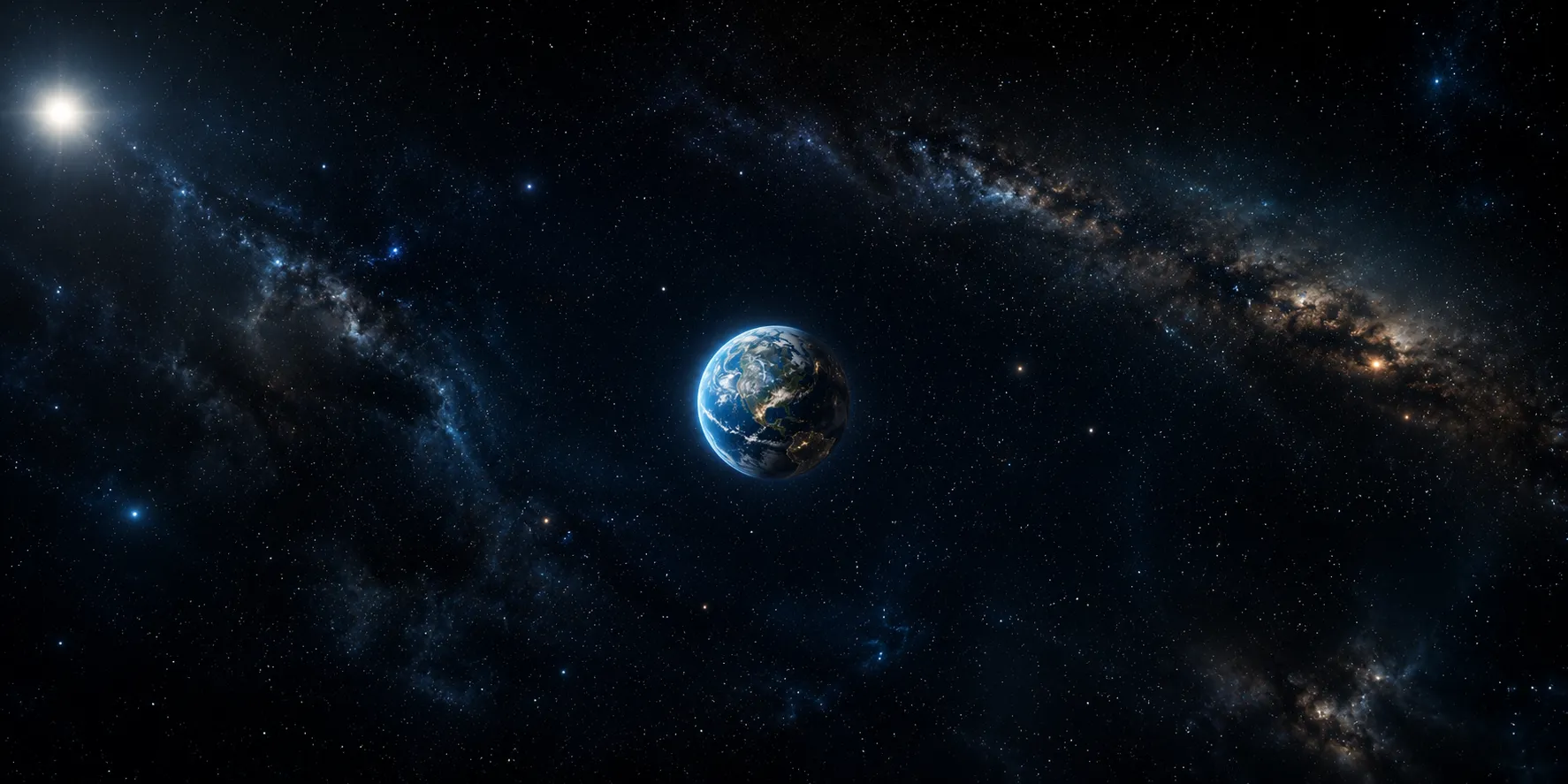
There is a remarkable saying in Job that can be translated as, “The earth stands on nothing” or “Earth rests upon nothing.”
## 📖 Bible Verse (KJV)
He extendeth his north over the desart, and hangs the earth on nothing.
— Job 26:7 (KJV)
## 📅 Approximate Year Written
The Book of Job is believed to be one of the oldest books in the Bible, having been written sometime between 2000 and 1500 BC.
## 🏛️ Historical Background
The book of Job is one of the most intriguing of all the books in Scripture. It delves into the mysteries of pain, God's wisdom, and the incompleteness of human knowledge of creation. Job speaks of God's greatness and power in Job chapter 26, over the heavens, the earth, and the natural world.
In Job's time, people did not have telescopes, satellites, scientific instruments. Much of the knowledge of the universe was acquired by observation and tradition. But in this ancient book there is a statement that is still gaining attention: The earth hangs "upon nothing.
## 🌍 What People Believed Then
There were many theories for Earth's support among the ancient civilizations.
In some cultures, it was believed that the earth was supported on gigantic pillars. Some people thought that it was on the back of a large animal or supported by the gods. As no one had ever been to space, they believed in myths and stories to explain the world around them.
The notion of these ideas was prevalent throughout the ancient Near East and across the globe. Job 26:7 describes a different scenario, however. Rather than it being the earth that rests on a concrete foundation, it is the earth that hangs on nothing.
Because of this difference, many readers have resorted to making comparisons with contemporary scientific understanding of the verse.
## 🔬 Modern Scientific Understanding
In modern times, astronomy has evolved to the conception that the Earth is a planet that revolves around the Sun within our solar system.
There are no pillars, mountains or physical supports for the earth. Rather than moving its way, it falls under the influence of gravity. The force that pulls things towards each other is called gravity. Earth's gravity prevents the atmosphere, oceans and all that is on the surface from drifting away from the Sun, and the Sun's gravity keeps Earth in orbit.
The Earth is estimated to orbit the Sun at about 107,000 km/h (66,500 mi/h) and spins on its axis every 24 hours.
In modern science, the view is that the earth is not supported by any visible structure but hangs in space.
## 🚀 Real-World Example
A prime example of this is in space exploration.
From the space station, astronauts take photos of Earth on an almost daily basis. Here, the planet Earth is depicted in a space with no foundation beneath it, and the general background is black space.
Space agencies like NASA, ESA, ISRO, and JAXA send satellites into space that circle the Earth and aid scientists in their research of weather systems, climate changes, communications, and navigation systems.
Each space photograph bears witness to the fact that the Earth is a free-floating planet in the great expanse of the universe.
## 💡 Easy Explanation
Suppose a ball is attached to a string and the string is swung in a circular motion.
Ball is always being pulled inwards by string and not flying away.
Gravity acts in a similar fashion. Earth's gravity is the force that keeps it in orbit around the Sun. The Earth orbiting around the Sun with the help of the gravitational force.
We cannot see gravity but its effects we can observe daily.
Oceans would flow away, the atmosphere would dissipate from the Earth, and life on Earth would not exist without gravity.
## 🤯 Did You Know?
The distance from the Sun to the Earth is about 149.6 million km or 93 million mi.
The period of one orbit of the Earth around the Sun is approximately 365.25 days.
The speed of the International Space Station around the earth is about 28,000 km per hour.
It is estimated that there are hundreds of billions of stars in our galaxy alone.
The first man made object into space was launched in 1957, more than 3,000 years after the book of Job was written.
## 🔍 Scientific Consensus
All scientists believe that Earth is in orbit around the sun and that this orbit is maintained by gravity.
Most Biblical scholars interpret Job 26:7 as poetic language which is meant to convey an understanding of God's power and wisdom, not a scientific lesson. It is interesting to note that the verse contrasts with many ancient conceptions of how the Earth was supported, but many of the readers of this blog will be interested in this.
Taken poetically or literally, the statement is among the most commented on passages in the Bible compared to modern science.
## 🙏 Spiritual Reflection
Job 26 is not an astronomy lesson, but a lesson about the greatness of God.
Job speaks of a Creator with power beyond the capacity of man. The universe is big, is orderly, is complex, and it's a reminder that there are things in the universe bigger than us.
Job 26:7 is a focus for believers on God who sustains and rules in the natural world with wisdom and purpose.
## 📌 Key Takeaway
Even long before telescopes, satellites and modern astronomy, the Bible said that the earth hung on nothing. Modern science has established that the earth is in orbit in space and that gravity keeps it moving. There is debate among scholars about the meaning of the verse, but Job 26:7 is one of the most intriguing of the biblical statements about nature.
## 📚 References
Scripture
The Holy Bible, King James Version (KJV)
* Job 26:7
### Scientific Sources
What is the Earth's elevation relative to the Sun?How high is the elevation of the Earth above the Sun?
2. NASA Earth Observatory
3. Encyclopaedia Britannica – Earth
4. Encyclopaedia Britannica – Gravity
5. International Space Station Facts (NASA)
7. St. Andrew's Cathedral, a church on the corner of M and 12th Streets.8. The Washington Monument, located in Lafayette Park.
### Historical Sources
The Encyclopedia’s sections on the ancient cosmologies illustrate this.The Encyclopedia's sections on ancient cosmologies exemplify this.
What Bible contains the largest number of words?Which Bible has the most words in it?
3. Zondervan Illustrated Bible Backgrounds Commentary
4. New Bible Dictionary (Historical Background of Job)
###Classification
Biblical Statement: Job 26:7
Established Science: Earth is held in place by gravity.
There is a debate as to whether Job 26:7 is a scientific statement or a poetic description.