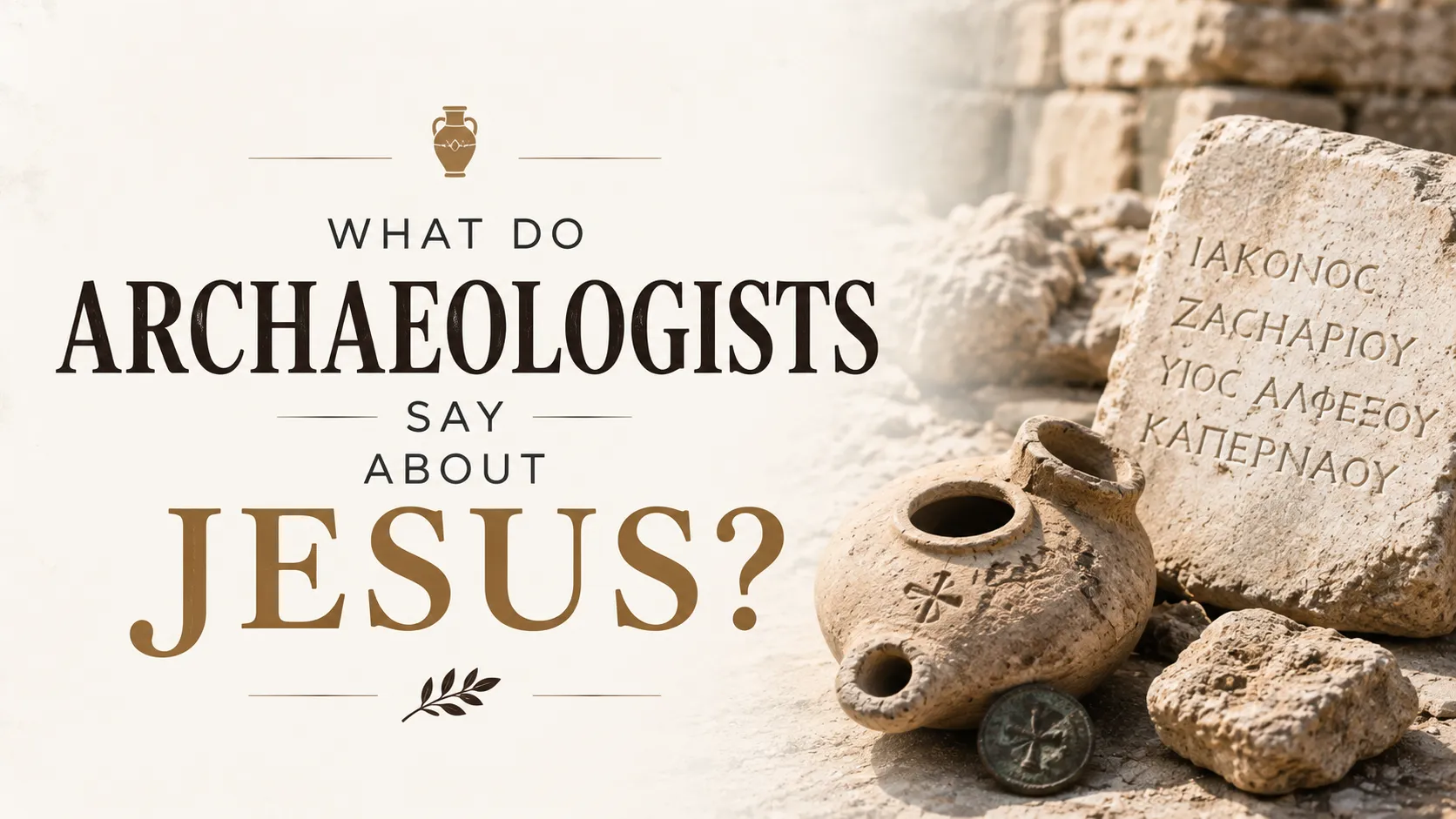
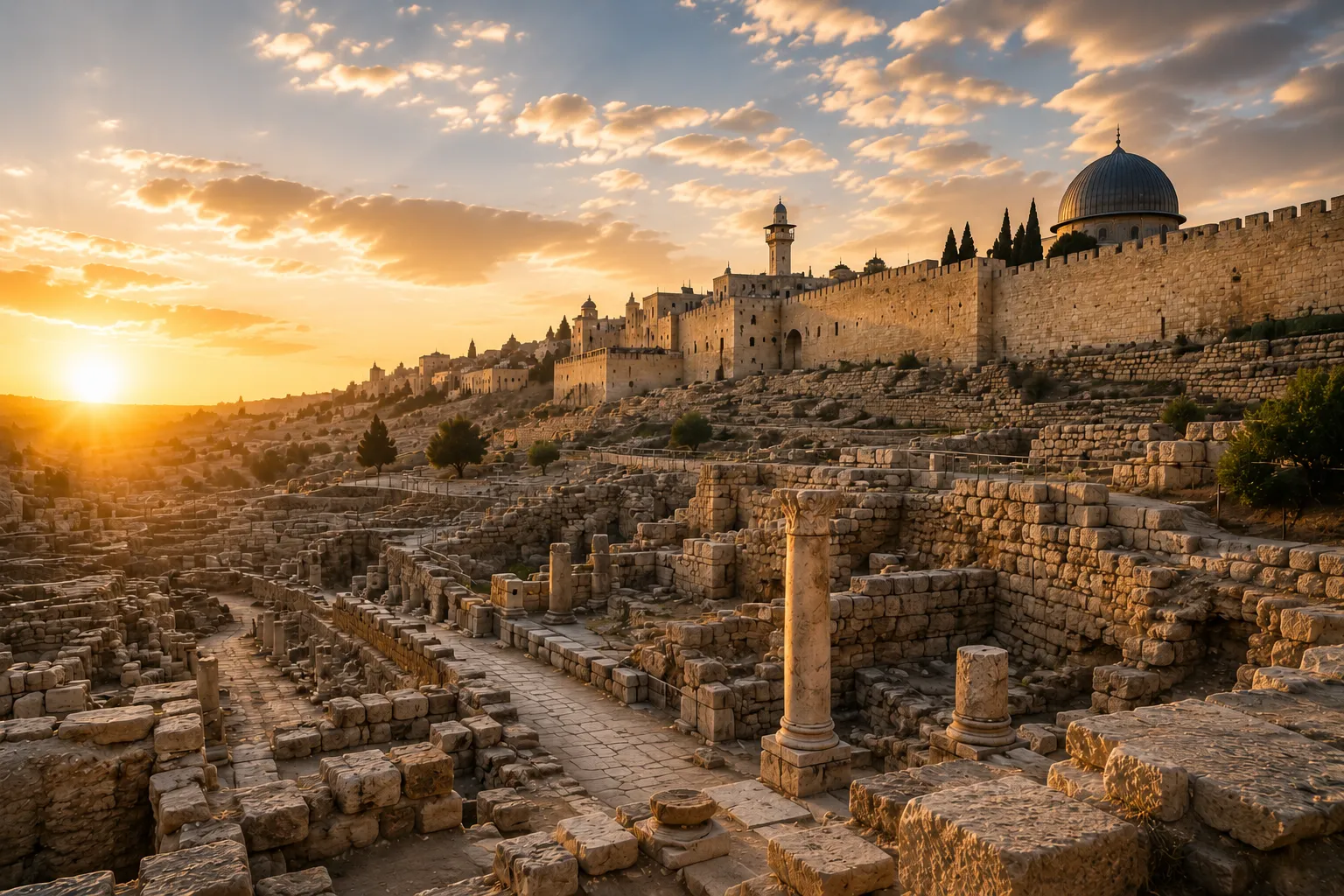
The Archaeology of Jerusalem is a write-up of the exploration of the ancient city of the Bible.
📖 Bible Verse (KJV)
Pray for the peace of Jerusalem: They shall prosper that love thee.
— Psalm 122:6 (KJV)
Additional Supporting Verse
Within thy gates, O Jerusalem will our feet stand.
— Psalm 122:2 (KJV)
📅 Approximate Year Written
Around 1000 BC
Psalm 122 is traditionally believed to be the work of King David, and is a song of praise for Jerusalem, the spiritual and political heart of Israel.
🏛️ Historical Background
One of the oldest inhabited cities in the world, Jerusalem has great significance to Judaism, Christianity and Islam. The Bible says that King David conquered Jerusalem and made it the capital of Israel. Subsequently the First Temple was constructed there by his son Solomon.
Jerusalem has seen the passing of many empires, invasions by foreign powers, pilgrimages of religions and historical events. The excavation of some parts of the city has been going on for more than 150 years as it is of great importance.
Jerusalem is still one of the most archaeologically studied sites in the world today.
What were the people's beliefs then?What did they believe about people?
Much of biblical Jerusalem was under the rubble of subsequent building for centuries.
The Babylonians, Persians, Greeks, Romans, Byzantines, Crusaders, Ottomans and recent development have all claimed ownership of the city and many of its ancient walls, streets, buildings and water systems have disappeared under newer settlements.
Until well into the era of scientific archaeology, people generally used only the Bible and historical writings to make sense of Jerusalem in the past.
Many of the physical aspects of the city have been uncovered by modern excavations.
The Archaeologists have uncovered several things.The Archaeologists have found a number of things.
Throughout Jerusalem, excavations have revealed amazing remains from many of the Biblical eras.
Major discoveries include:
The City of David
The ancient heart of Jerusalem, the City of David, has been identified by archaeologists and is believed to be the site around which the city was founded by King David in about 1000 BC.
Hezekiah's Tunnel
During the reign of King Hezekiah, an amazing water tunnel (Hezekiah's Tunnel) was dug 1750 feet long under the city of Jerusalem to keep the water coming to the city before the Assyrian invasion.
The tunnel is described in:
* 2 Kings 20:20
* 2 Chronicles 32:30
It is now possible to still walk through much of the tunnel.
The Pool of Siloam
The ancient Pool of Siloam was found once again in 2004.
Jesus commanded a man born blind to come there and wash before he got his sight!
The discovery of this pool verified that there was a pool of this kind during the time of Jesus.
The Broad Wall
The archaeological work revealed a portion of Jerusalem's Broad Wall, which is thought to have been constructed during King Hezekiah's reign, as the city readies itself for siege.
This wall is of the same period as mentioned in the Old Testament.
Artifacts: Ancient Clay Seals or Bullae.
A number of ancient clay seal impressions have been found in Jerusalem.
Some are named after men in the Bible that are important in the context of the kingdom of Judah, and so shed light on the city's political structure at that time.
🚀 Real-World Example
Jerusalem is a city of thousands of archaeologists who work there annually.
Tackling these structures and preserving the city's rich history, modern technologies such as laser scanning, ground-penetrating radar, 3D mapping, drone photography and digital reconstruction are used to study buried structures.
New finds are announced on a regular basis and Jerusalem is one of the world's busiest archaeological research sites.
💡 Easy Explanation
Suppose you had read a history book about an old city.
Now think about walking the streets of its city, entering its water tunnels, looking at its walls and touching the coins that its citizens used.
Archaeology enables historians to do just this.
Rather than just written descriptions, archaeologists dig up the remains of the city.
These finds enable us to learn more about the people that lived in biblical Jerusalem every day of their lives.
🤯 Did You Know?
Jerusalem has been a city for more than two-thirds of a millennium, that is, more than over five thousand years.
Over the last 2000 years, there have been over 2000 archaeological digs in and around the city.
Today's Old City is just to the north of the City of David.
The tunnel of Hezekiah is still open for visitors.
Jerusalem is the place where discoveries are made virtually annually.
Jerusalem is a holy city to Judaism, Christianity and Islam.
🔍 Historical Consensus
Archaeology has proved the long and complex history of Jerusalem, to which historians now generally agree.
Many of the walls, inscriptions, public building, coins, houses, streets, water systems, and seals dug up were of many eras referenced in the Bible.
Archaeology, however, can not prove everything that happened in the Bible or all the miracles.
It is most useful for giving a historical perspective that enables scholars to better understand the people, places and culture that are referred to in Scripture.
As is common with any archaeological research, there are many discoveries that continue to be debated about regarding their exact date and interpretations.
🙏 Spiritual Reflection
In the Bible, Jerusalem has a special significance.
It was the city of King David, the site of the building of Solomon's Temple, the focus of Jewish worship and the city where Jesus was born, taught, crucified and rose again in the New Testament.
Many believers who visit Jerusalem today, remember that the Bible was written in real locations that were actually lived in by real people.
While it can't take the place of faith, archaeology can enhance our understanding of the historical context of God's revelation.
📌 Key Takeaway
Jerusalem is one of the world's most significant archaeologically rich cities. Signs of ancient kings, buildings, water systems and every day life continue to be unearthed that give a glimpse into the historical background of the bible. Although there are some events in the Bible that can't be proven by archaeology, it can give you a lot of information about the city that's the center of biblical history.
📚 References
Scripture
Several people found it valuable to use the Bible, King James Version (KJV), while they were reading.
* Psalm 122:2, 6
* 2 Samuel 5
* 1 Kings 6
* 2 Kings 20:20
* 2 Chronicles 32:30
* John 9:7
Archaeological Sources
1. Israel Antiquities Authority (IAA)
He was the founding president of the City of David Foundation.
3. Israel Museum
4. Encyclopaedia Britannica – Jerusalem
6. Oxford Handbook of Archaeology in the Near East
Historical Sources
1. New Bible Dictionary
2.The Archaeological Study Bible
3. Zondervan Illustrated Bible Backgrounds Commentary
4.Published works of the Jerusalem Archaeological Park.
5. Biblical Archaeology Society
Classification
Speaker: Dr. Charles A. Wood, The University of Birmingham, UK
Historical Status: Jerusalem is one of the most extensively excavated ancient cities in the world – thousands of archaeological discoveries have been made over the course of several millennia.
Interpretation Status: Archaeological excavations have confirmed many aspects of the development of Jerusalem through history, and many sites connected with the Bible. While details of particular finds may differ in interpretation, the location of the city was historically significant.