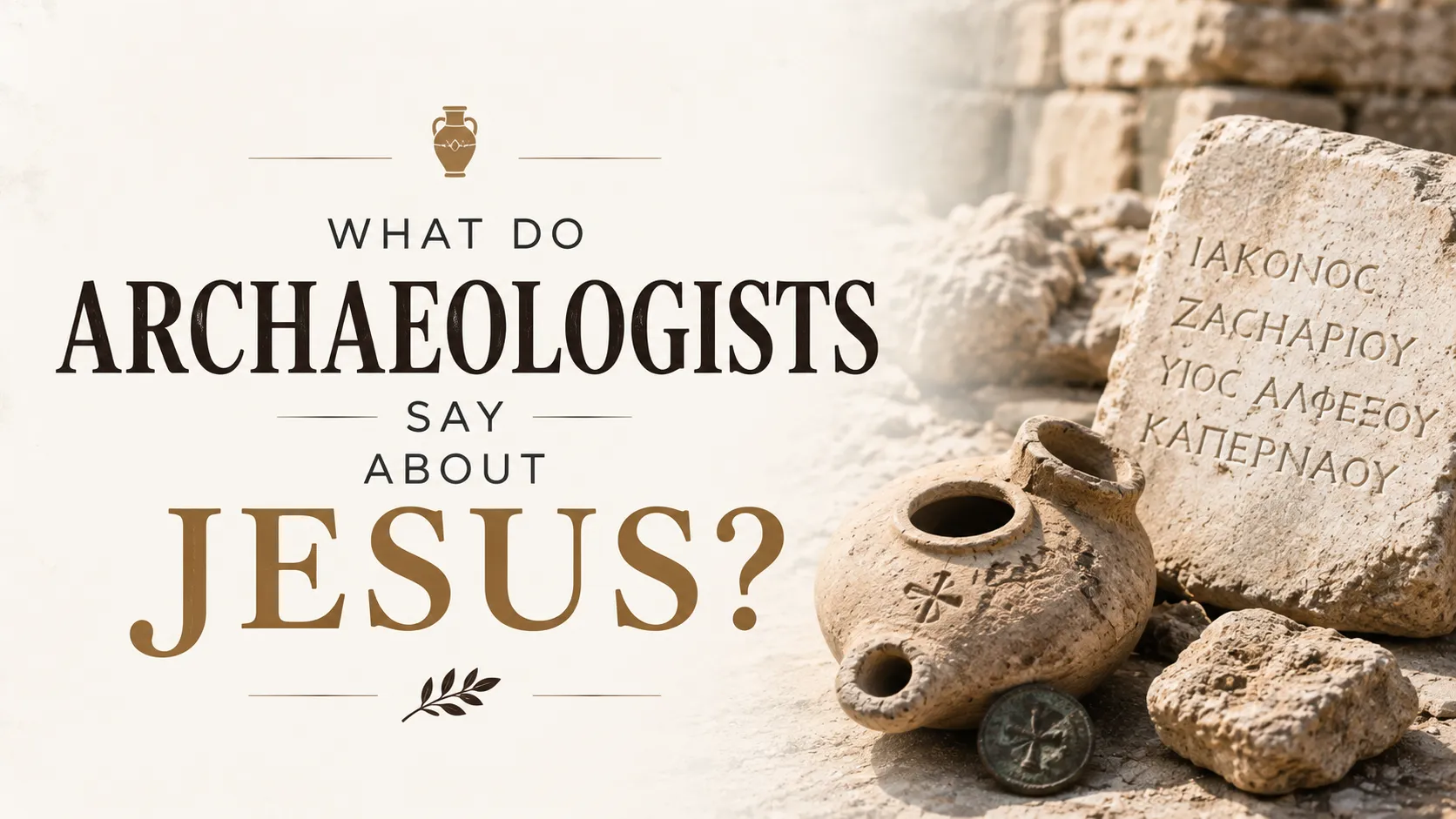
Can Archaeology Prove the Bible?
Is it possible to really use archaeology to prove the Bible? Recognizing the limitations and possibilities of the archaeological evidence
📖 Bible Verse (KJV)
Faith is the substance of things hoped for; the evidence of things not seen.
— Hebrews 11:1 (KJV)
Additional Supporting Verse
All the works of the LORD are great, sought of all them that have pleasure therein.
— Psalm 111:2 (KJV)
📅 Approximate Year Written
Hebrews: Around AD 60–70
Psalm 111: Around 1000–900 BC
🏛️ Historical Background
For centuries, historians, archaeologists and biblical scholars have been searching for biblical lands for the discovery of inscriptions, buildings and artifacts, seeking to find ancient cities.
The archaeological work, which began to develop during the Nineteenth Century, was the result of the expansion of excavation in Israel, Jordan, Egypt, Turkey, Iraq, and the surrounding areas.
Since then, thousands of discoveries have enabled researchers to learn more about the descriptive Scriptural material of people, governments, language, culture and daily life.
There's a lot of questions that many readers ask:
Is it possible to prove the Bible by using archaeology?
The response must be based on knowledge and understanding of the strengths and the limitations of archaeology.
What did people think then?So what was everyone's thinking back then?
The only sources for information about the ancient biblical world prior to the advent of archaeology were primarily from the written sources and religious beliefs.
Some people thought that some biblical kings, cities and officials were mythical because they did not find any physical evidence.
In the past two hundred years, the excavation of sites has grown, with a large number of the locations and names found in the Bible being verified in inscriptions and monuments, as well as by official seals, coins and ancient records.
But, as archaeology has also revealed, not every event in the Bible has a physical trace.
🔬 What Archaeology Can Do
Archaeology is the examination of the remains of past civilisations.
It can aid in establishing:
* Ancient cities.
* Buildings.
* Roads.
* Water systems.
* Coins.
* Pottery.
* Royal seals.
* Written inscriptions.
* Historical rulers.
* Government officials.
* Cultural customs.
* Trade routes.
Archaeology has yielded evidence that has been linked to:
The Pilate Stone is a confirmation of the historical existence of Pontius Pilate.
The Tel Dan Stele – containing the phrase 'House of David'.
Hezekiah's Tunnel, mentioned in the O.T.
The Pool of Siloam which is referred to in the Gospel of John.
Dead Sea Scrolls, which are ancient Hebrew documents.
These findings help us to better understand the context of the ancient world in which the Bible was written.
🚀 Real-World Example
Suppose you read the story of an ancient king in a history book.
A number of years later, the remains of the king's palace, his government records, his coins and his official seal are found.
The findings are in line with the theory that the king existed in history.
But it is not Archaeology that can prove all the things written about that king.
It cannot tell what he believed or dreamed of, nor can it know if God spoke to him.
This is the same with the Bible.
While archaeology can provide most of the historical details, it is not able to test spiritual claims.
💡 Easy Explanation
Imagine that you are assembling a big puzzle.
Each piece of the artifact is a puzzle piece.
One historical source is the Bible.
Other ancient inscriptions are yet another.
More pieces are added with buildings, pottery, and coins.
The more pieces that are found, the better the picture will become.
However, many of the artifacts may never be recovered as time, erosion, war, earthquakes and man have destroyed numerous ancient sites.
🤯 Did You Know?
The archaeologists have identified thousands of biblical locations in the Middle East.
The Dead Sea Scrolls contain biblical documents over 2,000 years old.
Israel is home to over 100,000 archaeological sites.
New finds are being announced virtually annually that are related to the biblical world.
Much of the ancient cities is still hidden under modern cities and cultivated fields.
🔍 Historical Consensus
The vast majority of historians have agreed that archaeology has verified the historical reality of many people, places, kingdoms and cultural practices mentioned in Scripture.
But there are some disadvantages to the discipline of archaeology.
It can't directly prove:
* Miracles.
*The raising of Jesus.
* God's existence.
* Divine inspiration.
* Prayer.
* Salvation.
These are to do with theology and faith, not material science.
Similarly, if an event cannot be found in the archaeological record, it does not necessarily mean that it never occurred. There are numerous sites which have not yet been excavated, and countless artifacts which have been lost or destroyed.
Historians therefore use other sources of information and written records in addition to archaeological finds to make evaluations.
🙏 Spiritual Reflection
Archaeological finds have not been the exclusive basis of the Christian faith.
It is good to use the word to study God's works and to know that faith is in God and not in an artifact.
Archaeology can shed light on the historical context of Scripture, and enable the reader to understand the life of Abraham, David, Isaiah, Jesus, Paul and many others.
These findings have added to the love of the Bible for many believers, and not taken the place of faith.
📌 Key Takeaway
Archaeology can not confirm all that is written in the Bible. It has established many historical personages, cities, rulers, customs and places referred to in Scripture. Faith is not the aim of archaeology, but rather a means to understanding the historical world in which the Bible was composed.
📚 References
Scripture
As a result, the Holy Bible, King James Version (KJV) is used.
* Hebrews 11:1
* Psalm 111:2
* Luke 19:40
Archaeological Sources
1.The Israel Antiquities Authority (IAA)
2.Official publication of the Biblical Archaeology Society (BAS).
3.International Schools of Pre-service Research (ISPR)
4. Oxford Encyclopedia of Archaeology in the Near East
In 5, the encyclopaedia Britannica is the subject of Biblical Archaeology.
Historical Sources
1. New Bible Dictionary
2. The Archaeological Study Bible
3.This resource is not designed to replace the authority of the Bible.This resource is not meant to take the place of the authority of the Bible.
4. Encyclopaedia Britannica – Archaeology
Classification
Topic: Biblical Archaeology
Historical Status: Archaeology is now a science in its own right, and has supported numerous historical facts recorded in the Bible.
Interpretation Status: Archaeology can help corroborate historical persons, places and cultures but cannot scientifically prove or disprove theological statements such as miracles, divine inspiration, or the existence of God.
This article is for educative purposes only. Biblical archaeology is the study of Scripture's history and culture using scientific techniques. Archaeological findings must be seen in context with the historical research, and there may be several interpretations of the findings offered by archaeologists, historians and biblical scholars.