The Water Cycle in the Bible
A Bible-Based Study of the Water Cycle: Does the Bible talk about the natural water cycle?
## 📖 Bible Verses (KJV)
“All the rivers run to the sea; thence the sea shall run no more.“All the rivers run to the sea; thence the sea is run no more.
— Ecclesiastes 1:7 (KJV)
### Additional Supporting Passage
For he maketh small the drops of water: they pour down rain on the earth according to the vapour thereof: which the clouds do drop and distil upon man abundantly.
— Job 36:27–28 (KJV)
## 📅 Approximate Year Written
Ecclesiastes: Around 940 BC
Job: Around 2000–1500 BC, making it one of the oldest books in the Bible.
## 🏛️ Historical Background
The Book of Ecclesiastes is about the patterns and cycles in life. In chapter one King Solomon talks about the regular rhythms in nature that God created. One of these observations is that water constantly flows between rivers and sea.
The Book of Job gives more detail in talking about water vapor, clouds and rain. These passages have been noticed together because they mention portions of the water cycle (or water cycles) as they are known today in science.
The Bible is not a textbook on meteorology, but it is to reveal to us God's wisdom and order in creation.
What people believed then?What did people believe in then?
To them, rivers, rain, lakes and oceans were a daily occurrence, but they did not know much about their interconnections.
Many knew that the rivers emptied into the ocean, but not many could know why the oceans never overflowed even though they were always being filled with water.
The fact that the water simply evaporated was very hard for them to grasp as water was lost from the surface of lakes and seas.
Before the advent of satellites, weather stations and scientific instruments, ancient people had no other means of observing the weather.
## 🔬 Modern Scientific Understanding
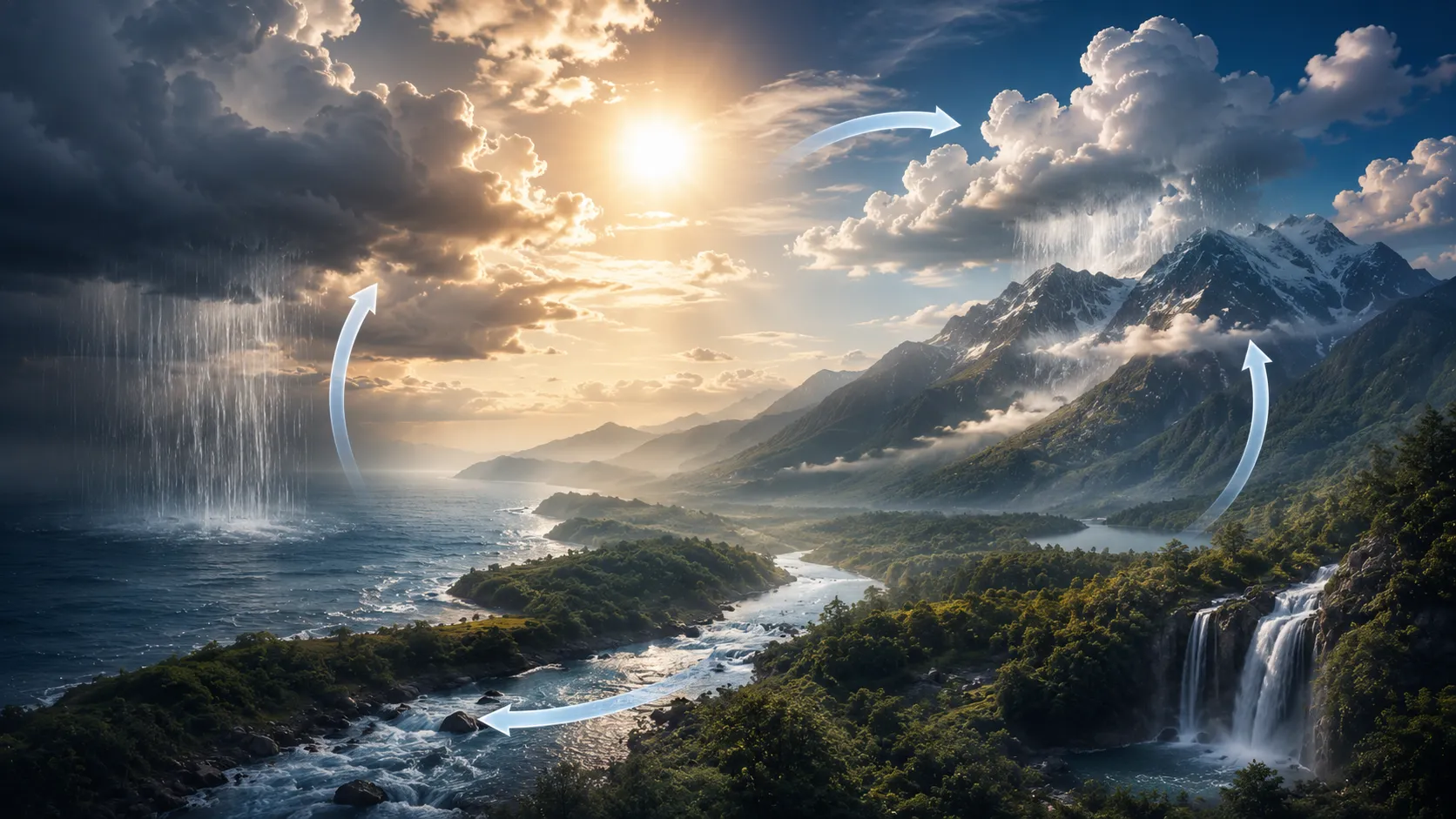
The water cycle is the name given to the continuous movement of water through the environment that is explained by modern science.
The cycle involves four stages, namely:
1. Evaporation
The Sun warms the water in oceans, rivers and lakes, making it water vapour and rising into the air.
2. Condensation
The water vapour condenses into little droplets which stick together to make clouds.
3. Precipitation
Once the droplets are large enough they descend to Earth as hail, sleet, snow or rain.
4. Collection
Water flows back to the rivers, lakes, underground reservoirs and oceans and it all repeats.
It has been going on for millions of years and is vital to the survival of all life on Earth.
## 🚀 Real-World Example
Meteorologists keep track of the water cycle each day by measuring water with satellites around the earth.
Satellites are utilized to calculate rainfall, cloud formation, evaporation, hurricanes, droughts, floods, and changing water levels all over the world by organizations like NASA.
Monsoon season is one of the most spectacular processes of the water cycle in India. Water flows from the Indian Ocean, where evaporates, is carried away by huge rain clouds, and falls as rain that fills the rivers and reservoirs, irrigates the farms and provides drinking water for the entire nation.
Agriculture, ecosystems and human civilization would not be viable without this process.
## 💡 Easy Explanation
Suppose you bring a pot of water to the boil.Suppose you bring a pot of water to the boil.
In the heating of the water, steam goes into the air.
The steam cools down and condenses into water droplets, when it encounters a cooler surface, such as a lid.
The process that occurs with water on Earth is also similar.
Water in oceans and rivers is heated by the Sun, and vaporizes into the air, unseen. High in the atmosphere it will turn into a cloud. Eventually, it returns to earth as rain and the cycle repeats itself.
Eath's water is always being recycled.
## 🤯 Did You Know?
Most of the water on Earth is in the oceans (about 97%).
Less than 3% is freshwater.
Only around 1% of freshwater is readily accessible for human consumption.
About 505,000 cubic kilometres of water evaporate from the surface of the earth each year, according to scientists.
Drinking water today could have come from sources thousands of years ago, such as a glacier, a dinosaur, a cloud or an ancient river.
## 🔍 Scientific Consensus
The water cycle is recognized as one of the most important natural systems on Earth and is wholeheartedly accepted by scientists.
Most scholars regard Ecclesiastes 1:7 as a description of the cycle that exists in nature, not a scientific description of meteorology.
The word rain is also used in Job 36:27–28, where there is also language that describes evaporation, clouds and rain. Many modern readers are amazed at the agreement of these verses with the findings of modern science regarding the flow of water, and all scholars stress the theological and poetic nature of these passages, rather than scientific statements describing the flow of water.
## 🙏 Spiritual Reflection
The water cycle is a reminder that God created a world of order, balance and renewal.
All the rain that falls here today has been in the continuous cycle of the Earth for countless generations.
God's faithfulness is like water, continually flowing to bring life to the earth, and generation after generation.
Water is a common symbol in the Bible that represents life, blessing, cleansing and renewal. The water cycle is a natural process that can be used to remind believers of the continual care that God gives to His creation.
## 📌 Key Takeaway
The Bible talked about rivers flowing into the sea and then it flowed back, and about rain coming out of the vapor.All this was talked about before modern weather, in the Bible. Nowadays, the processes can be explained by the water cycle. Although scripture is theological, many readers enjoy the parallel that can be drawn between the natural processes that they are familiar with, and the ancient observations.
## 📚 References
### Scripture
The Holy Bible, King James version (KJV)
* Ecclesiastes 1:7
* Job 36:27–28
* Psalm 104:10–13
### Scientific Sources
The Water Cycle is one of the images included in NASA Earth Observatory.Water Cycle is an image in NASA Earth Observatory.
The Water Cycle is the focus of the second activity, which is from the United States Geological Survey (USGS).
The NOAA – Water Cycle program provides funding for local water cycle projects.NOAA – Water Cycle program funds local water cycle projects.
Describes the movement of water in the water cycle.Describes how water moves in the water cycle.
The 5th National Geographic shows how the water cycle works.The 5th National Geographic tells the story of Earth's Water Cycle.
### Historical Sources
1. New Bible Dictionary
Like this, you will find 2nd Zondervan Illustrated Bible Backgrounds Commentary.
3. Encyclopaedia Britannica – Ecclesiastes
The Book of Job is currently included in the online version of the Encyclopaedia Britannica.
### Classification
Biblical Statement: Ecclesiastes 1:7; Job 36:27–28
Scientific Status: The water cycle is a scientifically accepted process and has been witnessed and studied for many centuries.
Interpretation Status:These are passages that are mostly poetic and theological. Their significance is often construed to be of observations that conform to the current knowledge of the hydrological cycle, and most readers do not read them as being scientific in nature.